Table of Contents
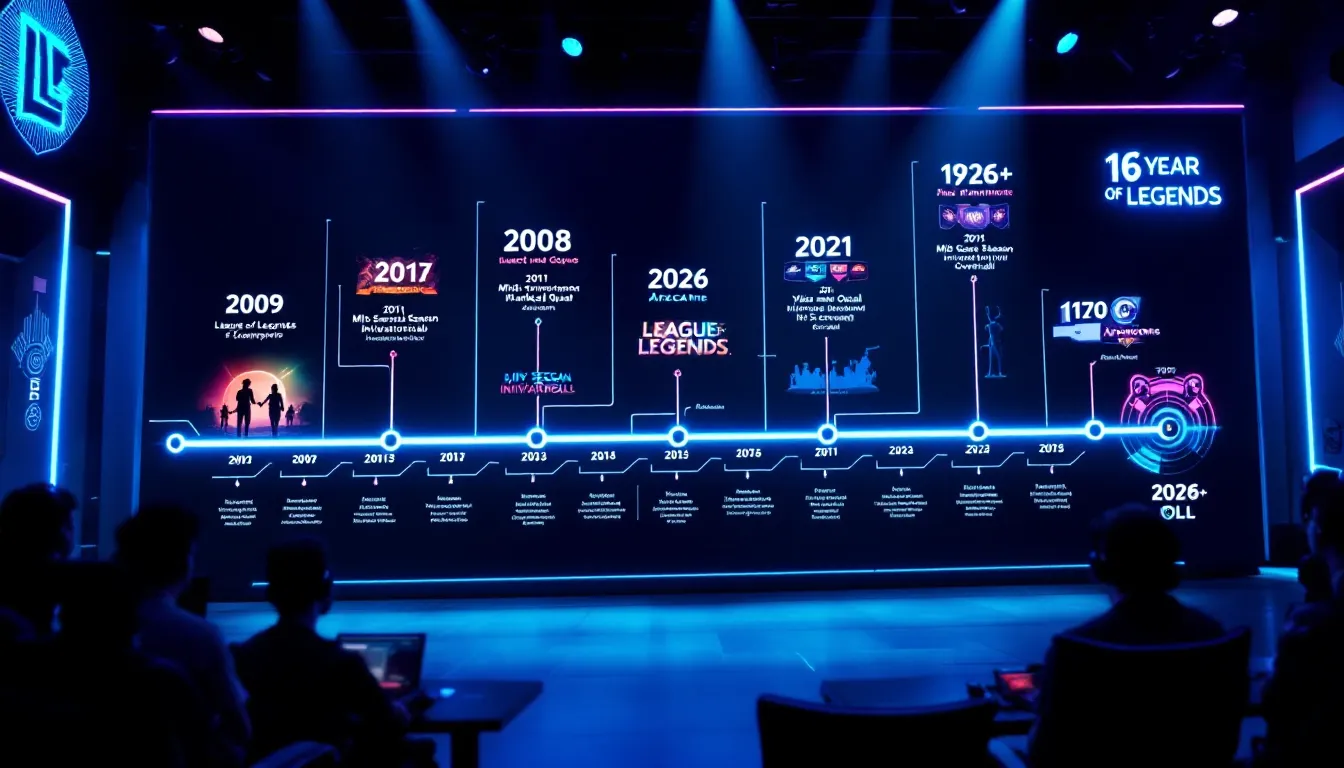
ToggleLeague of Legends isn’t just a game, it’s a cultural phenomenon that’s been reshaping competitive gaming and esports for over 15 years. If you’ve ever wondered how old League of Legends actually is or what’s happened to the game since its launch, you’re in the right place. As of 2026, Riot Games’ flagship MOBA has grown from a scrappy indie project into one of the most played games on the planet, with millions of players competing in Summoner’s Rift every single day. This article breaks down the complete timeline of League of Legends, from its humble beginnings to its current status as a gaming titan.
Key Takeaways
- League of Legends officially launched on October 27, 2009, in North America, making it 16 years old as of 2026, and has evolved from a scrappy indie project with 16 champions into a dominant gaming titan with 170+ champions and 150+ million monthly active players.
- How old is League of Legends in terms of competitive impact is demonstrated by its esports dominance: Worlds 2023 drew over 5 million peak concurrent viewers, with professional players earning $300,000+ annually in salaries alone, comparable to traditional sports.
- The game’s free-to-play model combined with cosmetic-only monetization revolutionized gaming business models, allowing anyone to compete without spending money while supporting continuous development through optional purchases.
- Arcane’s 2021 Netflix release transformed League of Legends into a legitimate cultural property beyond gaming, bringing millions of non-players into the ecosystem through stunning storytelling and animation.
- Riot Games expanded League of Legends into a multi-game ecosystem with Valorant, Teamfight Tactics, Legends of Runeterra, and Project L, creating interconnected experiences that drive player engagement across genres.
- At 16 years old, League of Legends continues receiving regular champion releases, balance updates, and map changes with no signs of slowing, while Riot plans additional transmedia content and potential cross-game integrations for the foreseeable future.
When Did League of Legends Launch?
League of Legends officially launched on October 27, 2009, in North America. That release marked the start of something massive, though few people could’ve predicted just how monumental the game would become. The game released on PC only, available to players in North America as a free-to-play title, a model that was still relatively unconventional for competitive games at the time.
The initial roster featured 16 champions, a far cry from the 170+ champions available today. Early players were experimenting with a game that drew inspiration from the Defense of the Ancients (DotA) mod for Warcraft III, but Riot Games put its own spin on the MOBA formula. The client was rough around the edges, ranked play didn’t exist yet, and the game had maybe a fraction of the polish you’d expect from a modern release. Yet somehow, it clicked.
By the end of 2009, League of Legends had already built a dedicated player base. Regional servers rolled out in subsequent years, Europe West in 2010, then Korea, Brazil, and others following. Each region would eventually develop its own pro scene, which set the stage for global competition. The game’s free-to-play model, combined with cosmetic-only monetization for champions (after a while) and skins, meant that anyone could jump in without dropping money on a title.
The Evolution of League of Legends Over 15+ Years
The Early Years: 2009-2012
The first three years of League of Legends were all about survival and refinement. Patches came out constantly, sometimes multiple per week, as Riot scrambled to balance champions and squash bugs. The client was notoriously clunky, the map had fewer details, and the whole experience felt scrappier than what veterans play today.
Ranked Solo/Duo queue launched in 2011, giving competitive players something to grind toward. The Elo rating system, borrowed from chess, provided a straightforward way to measure skill. Seasons began in 2012, introducing ranked rewards and seasonal resets that gave the game a structure beyond “just win games.” By the end of Season 1, the first League of Legends World Championship happened in Sweden with 1.7 million viewers, a number that seems quaint now but was staggering at the time.
Item diversity was low, builds were more straightforward, and the meta shifted wildly every patch. Supports barely existed as a role: you basically had a jungler and four laners. Vision mechanics were primitive. The game felt raw, but that rawness attracted hardcore players who wanted to master something new.
The Competitive Rise: 2013-2016
This era saw League of Legends transform into a legitimate esports juggernaut. Mid-season Invitational debuted in 2013, giving regions a chance to compete outside of Worlds. Franchising hadn’t arrived yet, but professional teams were forming, sponsorships were flowing, and salaries were rising. Players like Faker were becoming household names in gaming circles.
The meta evolved dramatically. Supports became essential. Item builds diversified. Champions that dominated early seasons (looking at you, Twisted Fate mid-lane carry from Season 1) got reworked or fell out of favor entirely. Tank junglers, burst mages, and ADC-support synergies defined the competitive landscape. Patch 5.5 and beyond introduced Runeglaive (a now-deleted item) that broke AP junglers, showing just how volatile balance could be.
Worlds viewership exploded. The 2013 Finals at the Staples Center drew 32,000 live viewers. By 2015, Worlds 2015 Finals (SKT T1 vs Fnatic) peaked at over 4 million concurrent viewers online. Korea was cementing itself as the premier region, with T1 winning back-to-back titles in 2015 and 2016.
Global Expansion: 2017-2020
Riot Games’ commitment to making League truly global bore fruit during this period. New regions opened: Turkish servers, Russian, Latin American servers split into two, and more. The professional ecosystem expanded massively. LEC (Europe), LCS (North America), LCK (Korea), and LPL (China) became the “big four” regions, with other secondary regions developing their own scenes.
The game’s map, Summoner’s Rift, received a massive visual overhaul in 2016 (patch 6.1 onwards), making it significantly more beautiful without changing gameplay. Runes Reforged launched in 2017, replacing the old rune system with a more flexible, accessible alternative that players could completely change between games. This single change made the game deeper and more diverse in build options.
Arcane’s cultural breakthrough didn’t happen until 2021, but the seeds were planted here. Riot was clearly thinking beyond the game, investing in narrative, lore, and universe-building. By 2020, the pandemic accelerated esports viewership, with Worlds 2020 pulling massive numbers even though the circumstances.
Modern Era and Beyond: 2021-2026
Arcane dropped in November 2021 and changed everything. A Netflix animated series that actually respected the game’s universe and delivered stunning storytelling brought millions of non-players into the League ecosystem. Suddenly, League wasn’t just a game, it was a legitimate cultural property. Season 12 (2022) introduced Chemtech Drake and updated the map significantly, creating massive meta shifts. Worlds 2022 saw T1 win their fourth championship with Faker still at mid-lane, cementing the organization as the greatest in esports history.
Project 2025 and beyond have focused on continuous balance updates, new champion releases (about one every 2-3 weeks), and regular VGU (Visual and Gameplay Update) reworks. The Durability Update in 2022 fundamentally changed how fights played out, emphasizing teamfighting and positioning over one-shot potential. Seasons have continued their yearly rhythm, with each bringing new ranked placements, battle pass cosmetics, and events.
By 2026, the game shows no signs of slowing down. Yes, newer competitors like Dota 2, Heroes of the Storm (revived in 2024), and others exist, but League maintains its dominant player base. The average player base hovers around 150+ million monthly active players globally, making it one of the top 5 most-played games period.
Major Expansions and Spin-Off Games
League of Legends: Arcane and Transmedia Success
Arcane wasn’t just a Netflix show, it was Riot Games’ statement that League of Legends existed beyond the game client. Season 1 (Act 1, 2, and 3) dropped in November 2021 and became a cultural phenomenon. The animation by Fortiche Productions was stunning, the writing was genuinely compelling, and it pulled in viewers who’d never installed League of Legends in their lives. The show’s focus on Vi, Powder/Jinx, and Caitlyn during the streets of Zaun versus the privileged districts of Piltover created a narrative that resonated far beyond gaming.
Arcane Season 2 continued the momentum, expanding into other champion storylines and deepening the world-building. Spin-off series have followed: Arcane spinoffs are in development, and Riot’s commitment to cinematic storytelling shows no signs of slowing. The K/DA and PROJECT music/visual franchises within League also blurred the line between game content and transmedia storytelling. Music albums, graphic novels, and lore expansions have all reinforced the universe.
Valorant, TFT, and the Riot Games Universe
League of Legends spawned a whole ecosystem at Riot. Valorant launched in 2020 as a tactical team-based shooter and has become a legitimate esports contender with franchised leagues across regions. It’s separate from League but shares the Riot ecosystem and player base crossover. Teamfight Tactics (TFT), the auto-battler game mode that emerged from League, went standalone on mobile and consoles, becoming a massive success in its own right.
Riot also released Legends of Runeterra (a CCG), Project L (a fighting game in development), and LoL Mobile (launching in select regions for mobile-first gaming). These aren’t just cash-grab spin-offs: they’re genuine expansions of the Runeterra universe. Each title feeds back into League, creating a network effect. A player might start with Arcane, jump into LoL Mobile, then try Valorant, and suddenly they’re deep in the Riot Games ecosystem. By 2026, this strategy of interconnected games across genres has solidified Riot as not just a League studio, but a genuine gaming publisher with multiple franchises. Players interested in League of Legends frequently explore content related to League of Legends Archives for builds, tips, and updates.
The Cultural Impact of League of Legends
Esports Dominance and World Championships
League of Legends World Championship has become THE event in esports. Worlds happens annually, and the finals viewership numbers are staggering. The 2023 Worlds Finals between T1 and Weibo Gaming drew over 5 million peak concurrent viewers, with the complete ecosystem (all languages, platforms, and regions combined) exceeding 100 million total viewers. That’s comparable to traditional sports viewership for major events.
Regional competitions, LEC, LCS, LCK, and LPL, function like traditional sports leagues, with franchising, sponsorship deals, and player salaries that rival professional athletes in traditional sports. A top-tier mid-laner or ADC can earn $300,000+ annually in salary alone, with sponsorships and streaming revenue on top. The competitive scene has also evolved to feature All-Star games, seasonal tournaments, and inter-regional competitions that keep esports fans engaged year-round. According to recent industry reports covered on Video game industry news sources, League’s esports ecosystem generates billions in annual revenue.
Player Base Growth and Global Community
League of Legends has maintained or grown its player base consistently over 15+ years, which is insane for any live-service game. The game’s accessibility, anyone with a decent PC (or now mobile) can play, combined with regular content updates, seasonal battle passes, and cosmetics keeps the grind fresh. The community itself spans languages and cultures: regional servers have developed distinct identities and metas.
In-game community events tie into real-world esports moments. When your favorite pro team wins Worlds, you might get a skin for your main champion. When a new region joins the esports scene, the in-game cosmetics celebrate it. This interplay between casual and competitive communities has been key to League’s longevity. Reddit communities, Discord servers, YouTube content creators, and streaming platforms have all organically grown around League, creating a feedback loop where new and returning players always have content to consume and learn from. Coverage of these developments regularly appears on gaming news platforms, where League features prominently in esports and gaming culture discussions.
What’s Next for League of Legends?
As of 2026, Riot Games hasn’t shown any signs of slowing development on League of Legends. The 15-year-old game is still receiving regular champion releases, balance updates, and map changes. Project L, the fighting game featuring League characters, is in development and expected to release within the next couple of years, which will introduce League’s champions to a new genre and audience.
One-for-All modes, URF, and rotating game modes keep casual players engaged while ranked grind seasons attract the competitive crowd. New items, rework cycles, and macro-level changes (like the Durability Update) ensure the meta doesn’t stagnate. Esports franchising has expanded into new regions, with new tier-2 and tier-3 leagues emerging to develop upcoming talent.
Riot’s investment in the Arcane universe means more transmedia content is coming. Additional animated series, manga, novels, and interactive experiences will continue expanding the lore. The company has also hinted at cross-game integrations, imagine playing Valorant cosmetics or cosmetics transferring between League and its spin-offs more seamlessly. Performance optimization and graphics updates keep the game visually competitive with newer titles. Regional servers will continue receiving dedicated attention, with dedicated esports broadcasts, localized content, and regional ranked systems.
The wildcard is whether League’s 15-year-old engine and client will eventually require a full rebuild. Speculation exists about a League of Legends 2 or a complete client overhaul, but Riot has been careful not to abandon its massive existing player base. Any major change would need to be backward-compatible and player-friendly. For now, the game operates as a living ecosystem, constantly evolving within its existing framework.
Conclusion
League of Legends is 16 years old in 2026, and it’s still the king of MOBAs. From its October 2009 launch with 16 champions to today’s ecosystem of 170+ champions, multiple game modes, esports franchises, and transmedia properties, the journey has been remarkable. What started as a scrappy indie project became a cultural juggernaut that influenced how games are monetized, how esports are structured, and how gaming communities organize themselves.
The game’s staying power comes from genuine quality, constant iteration, and Riot’s willingness to evolve without abandoning what made League great in the first place. Sure, balance patches come and go, champions get nerfed and buffed, and the meta shifts every season. But at its core, League of Legends delivers what it did in 2009: a competitive, skill-based team game that rewards teamwork, positioning, and game knowledge. The competitive scene continues to produce incredible moments, from legendary plays to underdog championship runs.
Whether you’re a Day 1 player who remembers Elo ratings and Twisted Fate mid-lane, a casual who jumps in during events, or someone who discovered League through Arcane, the game has something for everyone. At 16 years old and counting, League of Legends shows no signs of slowing down, and if Riot’s roadmap is any indication, the next 16 years should be just as wild as the last.