Table of Contents
ToggleYour League of Legends icon is more than just a tiny avatar, it’s your first impression in champion select, the face your teammates see, and sometimes, proof you’ve earned serious bragging rights. Whether you’re a casual player who wants something fresh or a grizzled veteran hunting for rare cosmetics, understanding how to get, change, and flex the right icon matters. In 2026, Riot’s expanded icon library and seasonal offerings mean there’s never been more variety. This guide walks you through everything: where to snag free icons, how to drop RP on limited cosmetics, how to switch them on any platform, and how to spot those ultra-rare icons that make other players’ jaws drop. Let’s break it down.
Key Takeaways
- A League of Legends icon is your account-wide profile picture that appears in champion select, loading screens, and post-match stats, serving as both cosmetic identification and achievement badges.
- Free League of Legends icons are obtainable through Honor Checkpoints (Level 2-5), seasonal event passes, ranked tier achievements, and login promotions, requiring no RP investment.
- Premium icons like Championship and Prestige editions cost 750–1350 RP and are time-gated; once an event ends, they’re permanently archived with no restocks or refunds.
- Changing your League of Legends icon takes 30 seconds on PC, console, or mobile, with unlimited swaps available and instant cross-platform syncing.
- Rare icons such as pre-2014 legacy icons, retired Worlds Championship editions, and Challenger tier badges command respect as they signal account longevity and achievement.
- Icon choice doesn’t affect gameplay but creates psychological impact—matching icons with skin themes, seasonal cosmetics, and event trends keeps your profile feeling intentional and current.
What Are League of Legends Icons?
A League of Legends icon is the circular profile picture that appears next to your summoner name in-game, in lobby, and across Riot’s ecosystem. It’s the visual identity you carry into every match, and it’s completely separate from your skin collection or emote setup.
Icons serve two core purposes. First, they’re cosmetic identification, your icon appears to teammates and enemies, broadcast on the loading screen, and displays in post-match stats. Second, many icons are achievement badges. Earning specific icons through honor levels, seasonal milestones, or ranked achievements tells a story about your playstyle and commitment. A player rolling with a 2023 Worlds Championship icon? That’s not random, they were there or earned it somehow.
Unlike skins, which apply to specific champions, icons are account-wide. You pick one, and it sticks until you change it. That simplicity is part of the appeal: low commitment, high visibility. Every summoner in your game sees it instantly.
How To Obtain League of Legends Icons
Icons come from multiple sources, and your acquisition method depends on whether you’re willing to spend RP and how much time you invest in seasonal content.
Free Icons Through Progression
Honor Checkpoints remain the easiest path to free icons. Reaching Honor Level 2, 3, 4, and 5 each grants a unique icon, no RP required, just consistent non-toxic behavior. These icons are relatively common but still carry implicit value: they signal respect from teammates.
Event Passes and Battle Academia missions frequently offer free icons. During events like Spirit Blossom or Star Guardian, missions reward icon shards or fragments that combine into full icons. You’ll need to grind a few hours, but it’s doable without spending.
Seasonal tier icons unlock at certain checkpoints if you play ranked. Silver, Gold, Platinum, Diamond, and Master tier icons are tied to end-of-season rank, reach it, finish the season there, and you earn that icon permanently. Many players use their highest-ever tier icon as a badge of honor.
Free icons also drop during login promotions. Riot occasionally gifts icons during new champion releases or anniversary events. Worth checking the client notification center.
Premium Icons and Cosmetics
If you want the flashiest or newest icons, RP is the path. Prestige Edition icons (tied to prestige skins) and special edition icons (like Star Guardian variants or Arcane crossovers) typically cost between 750 and 1350 RP. These are time-gated: once an event ends, they’re gone from the shop, period. No refunds, no restocks.
Championship icons are the premium prestige play. Limited to World Championship years, these icons cost around 1350 RP and are only available during their event window. Buying a 2025 Worlds icon in April 2026 isn’t happening, Riot archives them immediately after the event closes.
Legendary icon bundles occasionally combo an icon with other cosmetics. You might get an icon, emote, and ward skin as a bundle, which is often cheaper than buying separately.
Limited-Time Event Icons
Event icons are the lifeblood of the cosmetics calendar. Pentakill, K/DA, True Damage, and other music-themed universes release seasonal icons. These typically run for 2-4 weeks. Miss the window, and you’re hunting for secondhand accounts or waiting for a rereleases, which are rare.
Regional events also drop icons. If you’re in a region with a regional tournament, expect tournament-themed icons tied to that event’s run. Same time-locked logic: grab it during the event or move on.
Event tokens are the wild card. Some events let you earn tokens through passes or missions, which you convert into icon shards. This is slower but free if you’ve already bought the pass. The math: a 10-game pass ($9.99) might unlock 3-4 icons via tokens, making it roughly $2.50 per icon, not terrible if you’re already engaged with the event.
How To Change Your League of Legends Icon
Switching your icon is genuinely straightforward, but the exact process varies by platform. The good news: you own all your icons forever once unlocked. No deletion, no loss. You’re just picking which one to display.
Steps For PC and Console
On PC and Console (PlayStation, Xbox):
- Log into your League of Legends account via the launcher.
- Navigate to your Profile (top-left corner after login).
- Click the circular icon next to your summoner name, this is your current profile icon.
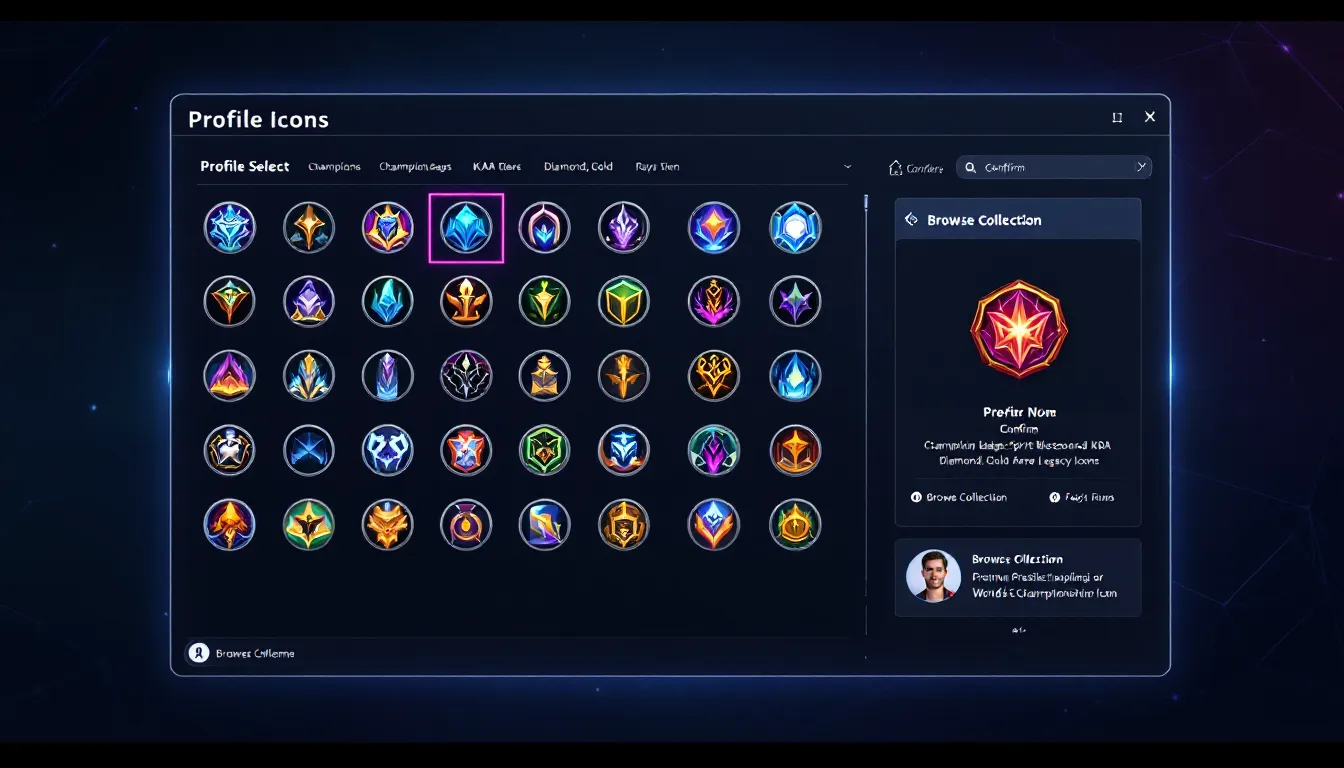
- A modal window opens showing your full icon collection, sorted by rarity, date unlocked, or category.
- Click any icon to preview it in the center of the screen. The preview updates in real-time.
- Hit Confirm or Apply, terminology varies by patch but it’s always the big button in the bottom-right.
- The change applies immediately. Reload your client if needed (rare).
The entire process takes 30 seconds. You can change your icon as often as you like, unlimited times. No cooldown, no cost. Swapping between your Honor 5 icon and a limited Worlds 2025 icon? Go wild.
Pro tip: Icons display larger in the profile preview than they do in-game. What looks detailed on your profile screen can be grainy at 32×32 pixels in match lobby. Pick one that’s visually clear when tiny.
Mobile App Changes
The League of Legends mobile app (available on iOS and Android) also handles icon changes, though the interface is slightly different.
- Open the app and log in.
- Tap your profile avatar in the bottom navigation.
- Tap Edit Profile or the gear icon.
- Select Icon from the profile customization menu.
- Browse your collection and tap any icon to preview.
- Confirm the selection.
Mobile app changes sync to PC instantly. If you swap on your phone at work, your PC client reflects it within seconds. Cross-platform consistency is seamless.
Rarest and Most Coveted Icons
Some icons are rarer than others. Age, event exclusivity, and unlock requirements create a tier system that savvy players recognize instantly.
Legacy Icons No Longer Available
Pre-2014 icons are extinct in the wild. Icons from the Dominion era, old tournament exclusives, and pre-refund system cosmetics are basically unobtainable unless you owned them before Riot archived them. A player flexing a 2011 Freljord icon? That’s a veteran stamp, they’ve been around since the Juggernaut patch was controversial.
Retired World Championship icons are the holy grail. Worlds 2015, 2016, 2017 icons are long gone. Getting hands on one means finding an old account that never re-branded or paying for account restoration (risky, technically against ToS). Worlds icons from 2018 onward are slightly easier to find but still uncommon among casuals.
Snowdown icons from 2012-2015 are similarly scarce. Riot cycled these annually but never re-released most of them. You’ll recognize them by their dated aesthetic, low-poly models, flat colors. That’s your signal: old loot.
Prestigious Championship Icons
Regional Championship icons (EU LEC, LCK, LPL, LCS) are more accessible than Worlds icons but still limited. released annually during each region’s playoffs, they’re available for 2-3 weeks. Most players who buy them during that window keep them. Seeing a 2024 LEC Spring icon? That person engaged with esports or snagged it on impulse.
Worlds Championship icons are the prestige currency. 2023 and 2024 Worlds icons are still relatively fresh and command respect. Worlds 2025 icons won’t be available until September 2026, so current possession is a statement. These typically cost 1350 RP, top-tier cosmetic pricing.
Ranked icon achievement: Reaching Challenger is rare enough that the Challenger icon is universally recognized as a hard-earned badge. Diamond icons are less rare but still indicate commitment. Master tier icons sit in the middle: exclusive enough to signal skill, common enough that top-tier players recognize it as “just” Diamond-adjacent. The icon hierarchy, unspoken but real, goes: Challenger > Master > Diamond > Platinum and below.
Flexing an old icon mixed with a current prestige skin is a power move. It signals longevity. A player running a 2018 Worlds icon + 2026 prestige skin has the account history to back up their cosmetics. That’s more impressive than a fresh account with all the newest stuff.
Icon Display and Visibility
Understanding where your icon appears and how to make it pop helps you maximize its visual impact.
Where Your Icon Appears In-Game
Your icon displays in several locations across League’s ecosystem:
- Loading Screen: Largest display. All 10 players’ icons appear in the team lineup before the game starts. This is the moment everyone sees your choice.
- In-Game HUD: Minimap corners show allied and enemy team icons at full player list. They’re small here, clarity matters more than detail.
- Post-Game Lobby: Your icon appears next to your name in the stats screen. This is where icons get scrutinized during the “gg” moment.
- Lolpedia/Spectator: If your game is spectated or broadcast, your icon displays on overlay graphics.
- Match History: Every replay and past game shows your icon from that date. You can’t change historical icons: you can only update your current one.
- Friend List & Client: Any friend browsing your profile sees your current icon.
The loading screen is the only place where icons are large enough for fine detail to matter. That’s why competitive players sometimes pick icons with clear visual hierarchy, sharp lines, high contrast. A dark icon on a dark background? Poor choice. A bright, complex icon with fine details? It’ll blur at 32×32 pixels.
Icon Customization Tips and Trends
Matching aesthetics: Icons work best when they align with your skin theme. Maining Ahri with Spirit Blossom skins? The Spirit Blossom Ahri icon ties it together. The matching is mostly psychological, but it’s part of character identity.
Seasonal alignment: Many players swap icons with the season. Prestiges rotate annually, so updating your icon to the newest prestige skin keeps your profile feeling fresh. In mid-2026, players hunting prestige icons will cycle through different cosmetics.
Competitive advantage: Icon choice doesn’t affect gameplay, but there’s a psychological element. Some players believe enemies take them more seriously if they’re flexing a rare icon. This is placebo, but placebo is half of mental game. A Worlds icon signals experience. A 2026 prestige icon signals current cosmetic engagement. Both read as “competent player.”
Rarity flexing: Some players hold onto ultra-rare icons specifically for impact. An old Victorious icon from a year they don’t main that role? Flex it. Icons are free to switch, so using a rare one isn’t a waste, it’s a statement.
Community trends shift seasonally. Winter brings Snowdown-themed icons into the spotlight. Worlds season (September-November) spikes Championship icon pickups. Spirit Blossom and K/DA events are perennial crowd-pleasers. If you want your icon to feel current without forcing it, players analyzing meta shifts on Mobalytics often highlight cosmetic trends alongside champion picks. The cosmetic meta is real, even if it’s invisible to balance patches.
Troubleshooting Common Icon Issues
Occasionally, icons glitch. It’s rare, but here’s how to handle it.
Icon not showing in collection: Log out and log back in. Client-side caches sometimes miss newly purchased icons. A full restart is the quickest fix. If it persists after 24 hours, contact Riot support with a screenshot showing the purchase receipt.
Icon changed itself: This doesn’t happen naturally. If your icon randomly reverted, someone may have accessed your account. Change your password immediately. Riot support can restore your icon choice if someone tampered with it.
Icon appears corrupted or pixelated: This is typically a driver or rendering issue, not an icon problem. Update your graphics drivers and try again. If it’s only one icon, re-download the patch (sometimes assets fail to fully sync).
Icon locked even though ownership: Rare exception: If you bought an icon during a period Riot later disabled (glitch in the shop, for example), it might be flagged as invalid. Riot support can verify ownership and unlock it. This almost never happens, but it’s worth noting.
Mobile app icon doesn’t match PC: Client syncing takes 5-10 minutes. If you changed your icon on mobile and the PC client hasn’t updated, wait a bit. If it’s been over an hour, force-close the PC client and relaunch.
For 99% of icon issues, League of Legends esports and official support has detailed resources, and Riot’s support portal is responsive. Icon issues are low-priority but quick to resolve. Submit a ticket with your summoner name, region, and a clear description. Response time is usually 24-48 hours.
If you’re experiencing broader account issues (locked summoner name, missing cosmetics), make sure you haven’t accidentally merged regions. Icon availability differs between regions: an icon purchased on NA might not be visible if you’re logged into EUW. Confirm your server before assuming it’s gone.
Conclusion
Your League of Legends icon might seem like a tiny cosmetic detail, but it’s a window into account history, playstyle, and aesthetic preference. Whether you’re grinding free icons through Honor levels, dropping RP on prestige cosmetics, or hunting legacy exclusives, the icon ecosystem rewards both patience and intention.
In 2026, icon variety is at an all-time high. Seasonal events, esports tie-ins, and thematic universes mean new icons arrive constantly. The strategy is simple: grab what resonates with you, swap freely without fear, and don’t stress the meta. Your icon should reflect your journey through Runeterra, not trends.
One final note: icon value is entirely social and psychological. No icon makes you a better player. But they make your profile feel intentional, and that matters in a game built on identity and community. Pick something that feels right, change it whenever you want, and enjoy the tiny flex. Flex culture starts small, right there in the loading screen.